
Miles Between the Moments
We’ve been keeping an eye on the Watch Duty app (which tracks wildfires and air quality across the state), trying to figure out when we could safely get back on the trail without risking our health—especially our lungs. Our original plan was to pick up where we ended last time at Twin Lakes, but with the fire evacuations reaching Twin Lakes, we decided to skip that section and head farther south.
Friday morning, July 10, we drove to Monarch Pass, where we had arranged to meet one of the Colorado Trail volunteer shuttle drivers. We’d leave our car there, then ride to Cottonwood Pass and begin a 43-mile backpacking trip back to our vehicle.
We waited about 45 minutes before receiving a text that our ride was having car troubles. Our only option then was to start hitchhiking.
It wasn’t long before Shawn pulled over and asked where we were headed. He was driving to Wyoming after finishing a 20-day work shift in Colorado. He told us he had slept in that morning and normally never picked up hitchhikers—but this time he made an exception and pulled over. Thanks, Shawn.
He drove us about an hour to Buena Vista, where we needed to turn west toward Cottonwood Pass. After thanking him, we climbed out and stuck our thumbs out once again, hoping another friendly driver would happen by.
Within 15 minutes, a white pickup pulled over. Trish rolled down her window and asked, “Are you headed to Cottonwood Pass?”
“Yes!” we replied and promptly climbed in.
Tracy was supporting her husband (trail name Blackbird), who was also hiking the Colorado Trail. She was on her way to pick him up for a resupply and rest day. We had a wonderful conversation as we drove up the pass road.
I’ve said it before, but the generosity of complete strangers never ceases to amaze me. Every ride has become more than transportation—it’s an opportunity to hear someone’s story and become a small part of their journey as well.


Arriving at Cottonwood Pass, we shouldered our packs just as a brief Colorado snow squall swept through, bringing graupel and wind, lasting all of five minutes.
The first five miles of this trail hold many memories for Glen and me. We’ve brought friends and family to Cottonwood Pass because it offers incredible alpine scenery just a short distance from the parking lot. As we walked, my mind relived those memories with our oldest daughter, Ruth; our middle daughter, Emily, and her husband, Mitch; Glen’s sister and brother-in-law, Marilyn and Karl; and just last summer, the Shewan family.

We climbed the first pass, descended the other side, and then tackled a second pass. The day was warm, and white, puffy clouds drifted over the Divide. We found ourselves reminiscing about a loop hike we had completed through this part of the Collegiate Peaks just a year ago. That evening, we camped in the very same spot we had used last year.
It’s a popular gathering place for both Colorado Trail and Continental Divide Trail hikers because of its plentiful flat campsites and reliable water, and a great place to swap stories with fellow through hikers. We were pretty tired after hiking 8½ miles and climbing roughly 2,500 feet—with hardly a break. We know better.
Day 2


Saturday morning, we woke feeling rested and made coffee as the sunrise began to glow orange in the east, no doubt enhanced by the wildfire smoke in the air. After packing up camp, we climbed another high pass and walked through beautiful alpine tundra graced with delicate wildflowers. By midday, we descended to Tincup Pass Road and crossed south into a new area of the Collegiate Peaks we’d never explored before.
The day became a series of climbs and descents. Glen and I kept repeating the mantra, “We go up so we can go down again.” It builds character.
It was a warm day, even though we were hiking between 10,000 and 12,000 feet.
Not every mile was spectacular.
Some stretches weren’t filled with sweeping vistas or dramatic peaks. They simply required physical and mental effort. Those are the moments when the question, Why am I doing this? inevitably surfaces.
The truth is, the Colorado Trail isn’t made up entirely of postcard views. There are plenty of ordinary miles that simply require persistence. But without those miles, you never reach the moments that make the journey unforgettable.

Saturday, we covered around 17 miles—not because that was our goal, but because there simply weren’t any suitable campsites near water.
During the afternoon and evening, we hiked through miles of beetle-killed forest. These standing dead trees are commonly called “widow makers” because they can fall without warning, especially when the wind picks up. You certainly want to avoid camping around these trees whenever possible.
By late evening, the trail finally climbed high enough to clear the trees. As we were scouting a campsite in an open willow meadow, we startled a herd of about 30 elk. We watched in amazement as they ran down into the trees. They must not have gone too far because around 2:30 the next morning, we were awakened by what sounded like at least one elk standing just outside our tent, snorting loudly enough to get our full attention.
The best tent site we could find was lumpy and on a slope, but it was late, and we needed to stop for the night. Though we were exhausted, sleep did not come easily on that lumpy tent site.

Day 3
Sunday brought a few more mountain passes and several beautiful alpine lakes.
While resting on a boulder beside the trail and enjoying the scenery, a solo hiker stopped to visit. We exchanged trail stories, and as we were about to part ways, we introduced ourselves.
“I’m Blackbird,” he said.
Glen and I both laughed.
“Your wife gave us a ride to Cottonwood Pass two days ago!”
What a small world.
By early Sunday afternoon, we had reached Hunt Lake, where we faced a decision. We could camp there after only 10 miles, or push on another 8½ miles, which would involve significant elevation gain and no more water or camping opportunities before reaching our car that evening.

Part of me really wanted to sleep in my own bed that night, but I was also hot and tired enough to know better. We decided to camp at Hunt Lake and finish the final miles in the cool of the morning.
Looking back, I’m incredibly grateful we made that decision.
Day 4
Monday morning, around 5:00 a.m., we switched on our headlamps, shouldered our packs, and quietly set off up the trail.
The cool morning air felt refreshing, and there’s something surprisingly enjoyable about climbing in the dark. When all you can see is the few feet illuminated by your headlamp, your world becomes wonderfully simple.


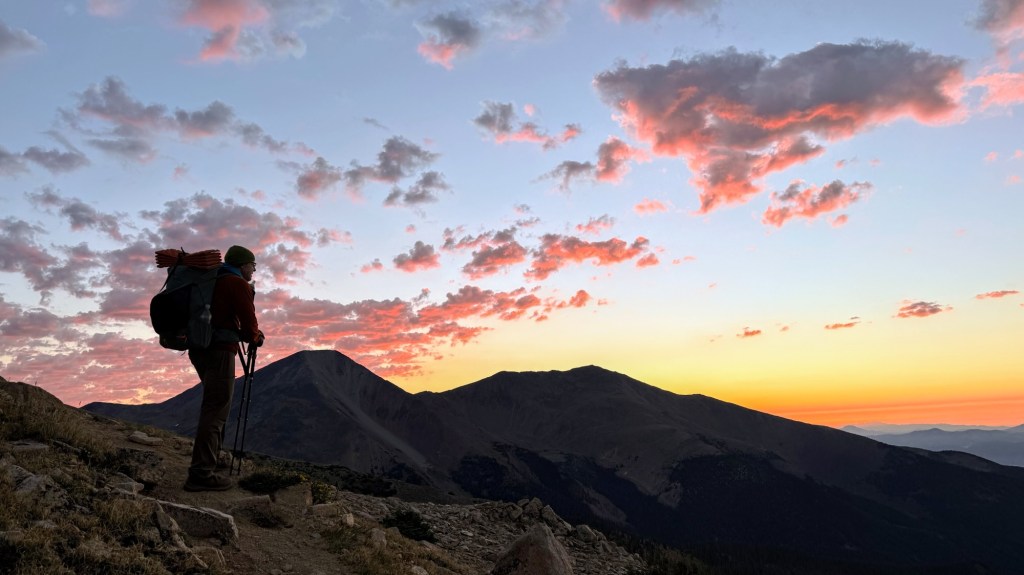
As we climbed toward the Continental Divide, the eastern sky began to glow orange long before the sun itself appeared.

The beauty energized us and seemed to draw us expectantly up the mountain as we raced the sunrise. We reached the pass at over 12,500 feet just as the sun crested the horizon. We both sat down on the tundra to soak in that magical moment together.

This is why we come to the mountains. This is why we hike the long, hard miles and sleep on lumpy tent sites. It’s for these magical moments, possible only because we’re willing to do the hard things required to reach these wild places. These quiet moments, experienced together and completely alone, are difficult to describe. They can’t be captured in a photograph or adequately explained with words.
Had we pushed on through our exhaustion in the heat of the previous afternoon, we would have missed what turned out to be the most memorable experience of the entire 43-mile weekend.
There’s a lesson somewhere in that decision not to push on. I’m still trying to figure out exactly what it is and how to put it into words.
But one thing I do know…
The beauty of the mountains God created, the days of silent hiking, and the reward of pushing myself each day, these things mysteriously restore my soul.
~Moose and Ptarmiglen


Our after-hike tradition: chips and cold drinks left in the car for our return.

 6th Decade Adventures